

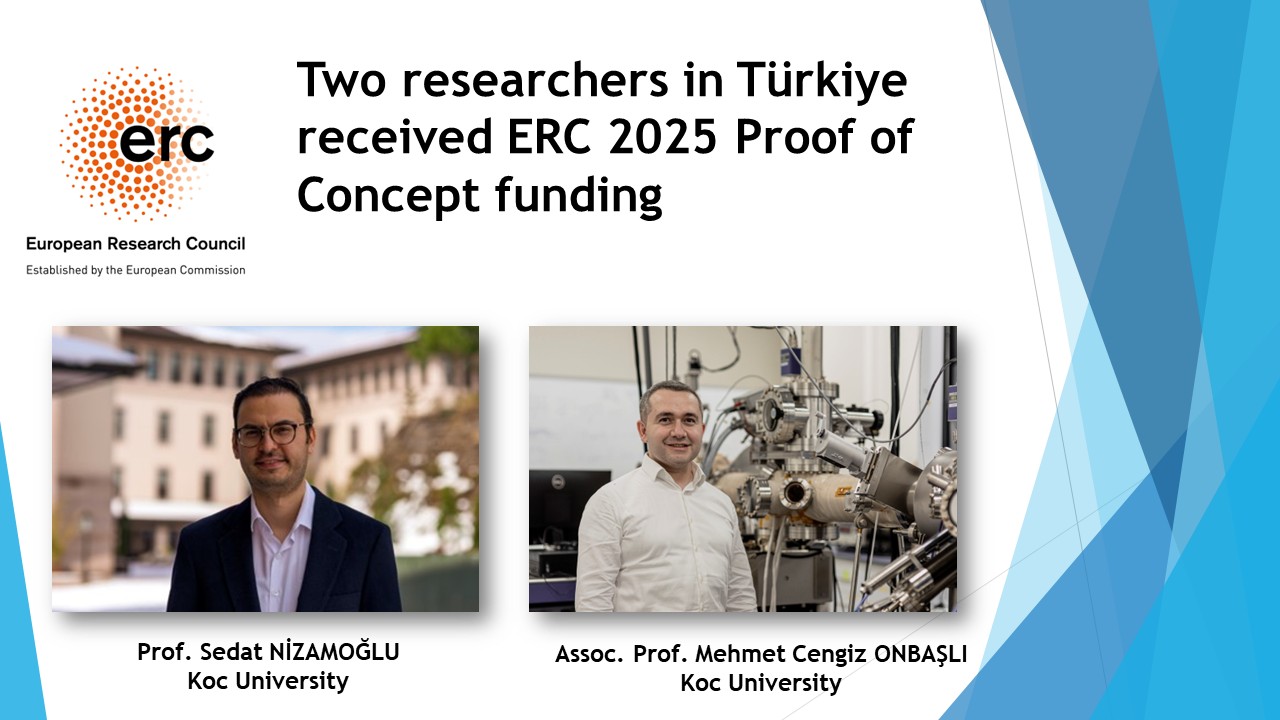
Our ERC Principal Investigators from Koç University, Prof. Dr. Sedat NİZAMOĞLU and Assoc. Prof. Mehmet Cengiz ONBAŞLI, have been awarded funding under the ERC 2025 Proof of Concept Call. We congratulate both of our distinguished researchers and wish them continued success in their work.
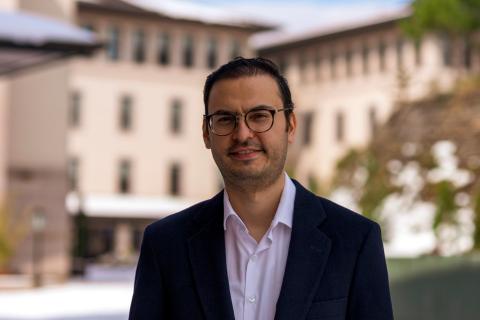
Prof. Sedat NİZAMOĞLU
The aim of Prof. NİZAMOĞLU’s Proof of Concept (PoC) project entitled "NORI: Nanocrystal Optoelectronic Implant for Optic Nerve Regeneration" is to develop a wireless, battery-free, and flexible implant that converts near-infrared light into localized and selective neurostimulation to treat irreversible vision loss caused by optic nerve damage. He and his team will experimentally validate the in vivo safety and regenerative efficacy of this implant. Overall, this study seeks to establish a clinically oriented roadmap for next-generation optoelectronic implants capable of supporting optic nerve regeneration.
Previously, NİZAMOĞLU received a Starting Grant titled "NOVELNOBI: Novel Nanoengineered Optoelectronic Biointerfaces" in the scope of ERC-2014-StG call and a Consolidator Grant titled "MESHOPTO: Retinal Mesh Optoelectronics" in ERC-2021-CoG call, securing a total of EUR 3.5 million in ERC funding. The NORI Proof of Concept project was submitted within the scope of the MESHOPTO project.
Currently hosted by Koç University, the MESHOPTO project aims to develop novel retinal implants against blindness by combining nanomaterials and unconventional electronic approaches, a concept they refer to as "retinal network optoelectronics."
 | Call: ERC-2025-PoC-DL2 Project Type: Proof of Concept Project Duration: 18 months Budget: 150,000 € Project Acronym: NORI Project Title: Nanocrystal Optoelectronic Implant for Optic Nerve Regeneration Project ID: 101292456 Host Institution: Koc University Panel: - Main ERC grant: MESHOPTO: Retinal Mesh Optoelectronics (ERC-2021-CoG, PE11) |
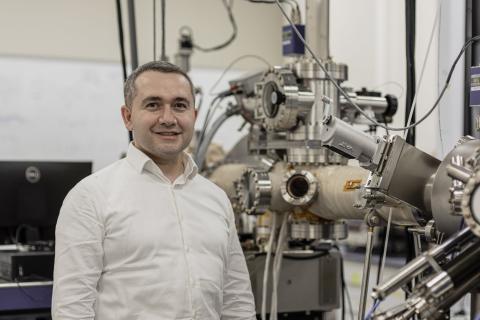
Assoc. Prof. Mehmet Cengiz ONBAŞLI
Assoc. Prof. ONBAŞLI’s PoC project entitled "AURORA: Acoustic Ultrahigh-Q Resonators for Oscillators, Radar, and Applications" aims to develop ultrahigh-Q bulk acoustic wave (BAW) resonators by combining advanced piezoelectric materials, phononic mode engineering, and scalable device architectures. The project targets compact, high-stability resonators for secure communications, radar, and next-generation timing and synchronization systems, with relevance to both civilian and defense technologies. The outcomes are expected to support future industrial demonstrators, IP generation, and technology transfer.
ONBAŞLI previously received a Starting Grant titled "SKYNOLIMIT: Ultralow power and ultra-wideband spintronics near thermodynamic limits"in ERC-2020-StG Call and another Proof of Concept Project titled "SuperPHOTON: 2D Topological Superconducting Single Photon Detector Devices" in ERC-2022-PoC-DL2 call, securing a total of 2.65 million € in ERC funding.
Currently hosted by Koç University, the SKYNOLIMIT project aims to redesign the fundamental building blocks of electronic circuits by leveraging the spin of electrons through an entirely new physics and chemistry approach
 | Call: ERC-2025-PoC-DL2 Project Type: Proof of Concept Project Duration: 18 months Budget: 150,000 € Project Acronym: AURORA Project Title: Acoustic Ultrahigh-Q Resonators for Oscillators, Radar, and Applications Project ID: 101293210 Host Institution: Koc University Panel: - Main ERC grant: SKYNOLIMIT: Ultralow power and ultra-wideband spintronics near thermodynamic limits (ERC-2020-StG, PE7) |
“The European Research Council (ERC) evaluates frontier research projects and the scientists who carry them out solely on the basis of scientific excellence, with a particular focus on projects that are multidisciplinary or interdisciplinary and that involve novel ideas and unconventional, innovative approaches. Projects funded under the Proof of Concept (PoC) calls are awarded to Principal Investigators who have previously received ERC funding, to support additional activities that validate the commercial and/or socio-economic potential of their ERC-funded research and contribute to the commercialization of their ideas.